
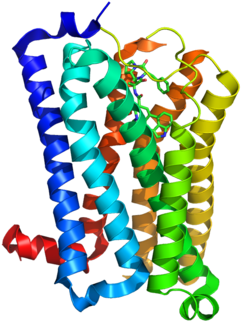
Серотониновые рецепторы (5-HT-рецепторы) — рецепторы, активируемые нейромедиатором и гормоном серотонином (5-HT). Они относятся к группам мембранных, сопряжённых с G-белком, лиганд-зависимых ионных каналов (ионотропных).[1][2][3] Рецепторы 5-HT расположены в центральной и периферической нервной системе, и опосредуют как возбуждающую, так и тормозящую нейротрансмиссию. Рецепторы серотонина взаимодействуют со множеством лекарственных средств и психоактивных веществ, серотонин является их эндогенным лигандом.
Серотониновые рецепторы модулируют высвобождение многих нейромедиаторов: глутамата, ГАМК, дофамина, норадреналина и адреналина, ацетилхолина, а также многих гормонов: окситоцина, пролактина, вазопрессина, кортизола, АКТГ и субстанции P. Эти рецепторы влияют на различные физиологические процессы, такие как аппетит, агрессия, тревога, познание, обучение, память, настроение, тошнота, сон и терморегуляция. Они являются мишенями медикаментов, в том числе психотропных, в том числе наркотических веществ, например галлюциногенов и эмпатогенов. Антидепрессанты, нейролептики, аноректики, противорвотные препараты, прокинетики, противомигренозные препараты затрагивают серотониновые рецепторы.[4]
Рецепторы серотонина обнаружены почти у всех животных и, как известно, даже регулируют продолжительность жизни и поведенческое старение у примитивной нематодыCaenorhabditis elegans[5][6].
История
Впервые неоднородность серотониновых рецепторов была показана в опытах Gaddum, Picarell (1957): способность серотонина сокращать гладкие мышцы блокировалась диэтиламидом Д-лизергиновой кислоты (ЛСД), а свойство возбуждать вегетативные ганглии предотвращалось морфином. Соответствующие рецепторы были названы Д- и М- серотониновыми рецепторами. И. Н. Пидевич (1962, 1965) показала, что рефлекторные реакции на серотонин, возникающие с серотониновых рецепторов чувствительных волокон блуждающего нерва, не угнетаются ЛСД и морфином, но конкурентно блокируются типиндолом. Соответствующие рецепторы были названы рецепторами серотонина Т типа.
Позднее места связывания серотонина стали изучать с помощью меченых лигандов, удалось клонировать рецепторы. С использованием новых возможностей были выделены семь семейств рецепторов серотонина: 5-НТ1, 5-НТ2 (Leysen и соавторами,1979, 1981), 5-НТ3, 5-НТ4, 5-НТ5, 5-НТ6 и 5-НТ7. Некоторые из этих семейств рецепторов имеют подтипы. По мере накопления данных, касающихся роли и фармакологической характеристики рецепторов 5-НТ1-7, появились основания предполагать, что рецепторы 5-НТ2 близки или идентичны Д-рецепторам серотонина; рецепторы 5-НТ3 соответствуют рецепторам серотонина Т-типа; рецепторы 5-НТ4 сходны с М-серотониновыми рецепторами. В дальнейшем была выделена классификация серотониновых рецепторов отдельно от рецепторов дофамина. Рецепторы серотонина метаботропны, состоят из семи доменов и связаны с G-белками, за исключением ионотропного семейства 5-HT3. В 2014 году у маленькой белой бабочки Pieris rapae был выделен новый рецептор 5-HT, получивший название pr5-HT8. Он не встречается у млекопитающих и имеет относительно малое сходство с известными классами рецепторов 5-HT.
Классификация
Подтипы
Следует отметить, что 5-НТ1С рецептор после клонирования и дополнительной характеристики, был причислен к семейству 5-HT2 и переименован в 5-НТ2С, поскольку имеет больше общего с этим семейством, нежели с 5-НТ1.
Очень неселективные агонисты 5-HT подтипов рецепторов включают эрготамин (средство против мигрени), которое активирует 5-HT1A, 5-HT1D, 5-HT1B, D2 рецепторы, а также рецепторы норадреналина[32]. ЛСД (психоделик) представляет собой агонист следующих 5-НТ рецепторов: 5-HT1A, 5-НТ2А, 5-HT2C, 5-HT5A, 5-НТ5, 5-НТ6[32].
См. также
Ссылки
- Серотониновые рецепторы — medbiol.ru
Примечания
- ↑Vincent Beliveau, Melanie Ganz, Ling Feng, Brice Ozenne, Liselotte Højgaard, Patrick M. Fisher, Claus Svarer, Douglas N. Greve, Gitte M. Knudsen. A High-Resolution In Vivo Atlas of the Human Brain's Serotonin System (англ.) // The Journal of Neuroscience. — 2017-01-04. — Vol. 37, iss. 1. — P. 120–128. — ISSN0270-6474. — doi:10.1523/JNEUROSCI.2830-16.2016.
- ↑Basic neurochemistry: molecular, cellular and medical aspects / George J. Siegel. — 6. ed. — Philadelphia, Pa.: Lippincott Williams & Wilkins, 1999. — 1183 с. — ISBN 978-0-397-51820-3.
- ↑P.B. Bradley, G. Engel, W. Feniuk, J.R. Fozard, P.P.A. Humphrey, D.N. Middlemiss, E.J. Mylecharane, B.P. Richardson, P.R. Saxena. Proposals for the classification and nomenclature of functional receptors for 5-hydroxytryptamine // Neuropharmacology. — 1986-06. — Т. 25, вып. 6. — С. 563–576. — ISSN0028-3908. — doi:10.1016/0028-3908(86)90207-8.
- ↑David E. Nichols, Charles D. Nichols. Serotonin Receptors (англ.) // Chemical Reviews. — 2008-05-01. — Vol. 108, iss. 5. — P. 1614–1641. — ISSN0009-2665. — doi:10.1021/cr078224o. Архивировано 5 января 2024 года.
- ↑Hana Murakami, Karalee Bessinger, Jason Hellmann, Shin Murakami. Manipulation of serotonin signal suppresses early phase of behavioral aging in Caenorhabditis elegans (англ.) // Neurobiology of Aging. — 2008-07. — Vol. 29, iss. 7. — P. 1093–1100. — doi:10.1016/j.neurobiolaging.2007.01.013. Архивировано 23 февраля 2024 года.
- ↑Hana Murakami, Shin Murakami. Serotonin receptors antagonistically modulate Caenorhabditis elegans longevity (англ.) // Aging Cell. — 2007-08. — Vol. 6, iss. 4. — P. 483–488. — ISSN1474-9718. — doi:10.1111/j.1474-9726.2007.00303.x. Архивировано 5 января 2024 года.
- ↑ 12Nelson, D. L. 5-HT5 receptors : [англ.] : [арх. 11 ноября 2011] // Current drug targets. CNS and neurological disorders. — 2004. — Vol. 3, no. 1. — С. 53—58. — doi:10.2174/1568007043482606. — PMID14965244.
- ↑Tomkins D.M., Higgins G.A., Sellers E.M. Low doses of the 5-HT1A agonist 8-hydroxy-2-(di-n-propylamino)-tetralin (8-OH DPAT) increase ethanol intake (англ.) // Psychopharmacology[англ.] : journal. — Springer, 1994. — Vol. 115, no. 1—2. — P. 173—179. — doi:10.1007/BF02244769. — PMID7862892.
- ↑Müller C.P., Carey R.J., Huston J.P., De Souza Silva M.A. Serotonin and psychostimulant addiction: focus on 5-HT1A-receptors (англ.) // Prog Neurobiol. : journal. — 2007. — Vol. 81, no. 3. — P. 133—178. — doi:10.1016/j.pneurobio.2007.01.001. — PMID17316955.
- ↑Carey R.J., DePalma G., Damianopoulos E., Shanahan A., Müller C.P., Huston J.P. Evidence that the 5-HT1A autoreceptor is an important pharmacological target for the modulation of cocaine behavioral stimulant effects (англ.) // Brain Res.[англ.] : journal. — 2005. — Vol. 1034, no. 1—2. — P. 162—171. — doi:10.1016/j.brainres.2004.12.012. — PMID15713268.
- ↑ 12de Boer S.F., Koolhaas J.M. 5-HT1A and 5-HT1B receptor agonists and aggression: a pharmacological challenge of the serotonin deficiency hypothesis (англ.) // Eur J Pharmacol.[англ.] : journal. — 2005. — Vol. 526, no. 1—3. — P. 125—139. — doi:10.1016/j.ejphar.2005.09.065. — PMID16310183.
- ↑Parks C.L., Robinson P.S., Sibille E., Shenk T., Toth M. Increased anxiety of mice lacking the serotonin1A receptor (англ.) // Proceedings of the National Academy of Sciences of the United States of America : journal. — 1998. — Vol. 195, no. 18. — P. 10734—10739. — doi:10.1073/pnas.95.18.10734. — PMID9724773. — PMC 27964.
- ↑Ebenezer I.S., Arkle M.J., Tite R.M. 8-Hydroxy-2-(di-n-propylamino)-tetralin inhibits food intake in fasted rats by an action at 5-HT1A receptors (англ.) // Methods Find Exp Clin Pharmacol. : journal. — 1998. — Vol. 29, no. 4. — P. 269—272. — doi:10.1358/mf.2007.29.4.1075362. — PMID17609739.
- ↑ 12Wouters W., Tulp M.T., Bevan P. Flesinoxan lowers blood pressure and heart rate in cats via 5-HT1A receptors (англ.) // Eur J Pharmacol.[англ.] : journal. — 1998. — Vol. 149, no. 3. — P. 213—223. — doi:10.1016/0014-2999(88)90651-6. — PMID2842163.
- ↑ 12Horiuchi J., McDowall L.M., Dampney R.A. Role of 5-HT(1A) receptors in the lower brainstem on the cardiovascular response to dorsomedial hypothalamus activation (англ.) // Auton Neurosci.[англ.] : journal. — 2008. — Vol. 142, no. 1—2. — P. 71—6. — doi:10.1016/j.autneu.2008.06.004. — PMID18667366.
- ↑Nalivaiko E., Ootsuka Y., Blessing WW. Activation of 5-HT1A receptors in the medullary raphe reduces cardiovascular changes elicited by acute psychological and inflammatory stresses in rabbits (англ.) // Am J Physiol Regul Integr Comp Physiol. : journal. — 2005. — Vol. 289, no. 2. — P. R596—R604. — doi:10.1152/ajpregu.00845.2004. — PMID15802554.
- ↑ 12Lucot JB. Antiemetic effects of flesinoxan in cats: comparisons with 8-hydroxy-2-(di-n-propylamino)tetralin (англ.) // Eur J Pharmacol.[англ.] : journal. — 1994. — Vol. 253, no. 1—2. — P. 53—60. — doi:10.1016/0014-2999(94)90756-0. — PMID8013549.
- ↑Winstanley C.A., Theobald D.E., Dalley J.W., Robbins TW. Interactions between serotonin and dopamine in the control of impulsive choice in rats: therapeutic implications for impulse control disorders (англ.) // Neuropsychopharmacology. : journal. — 2005. — Vol. 30, no. 4. — P. 669—682. — doi:10.1038/sj.npp.1300610. — PMID15688093.
- ↑Ogren S.O., Eriksson T.M., Elvander-Tottie E., D'Addario C., Ekström J.C., Svenningsson P., Meister B., Kehr J., Stiedl O. The role of 5-HT(1A) receptors in learning and memory (англ.) // Behav Brain Res.[англ.] : journal. — 2008. — Vol. 195, no. 1. — P. 54—77. — doi:10.1016/j.bbr.2008.02.023. — PMID18394726.
- ↑Yasuno F., Suhara T., Nakayama T., Ichimiya T., Okubo Y., Takano A., Ando T., Inoue M., Maeda J., Suzuki K. Inhibitory effect of hippocampal 5-HT1A receptors on human explicit memory (англ.) // American Journal of Psychiatry : journal. — 2003. — Vol. 160, no. 2. — P. 334—340. — doi:10.1176/appi.ajp.160.2.334. — PMID12562581.
- ↑Kennett G.A., Dourish C.T., Curzon G. Antidepressant-like action of 5-HT1A agonists and conventional antidepressants in an animal model of depression (англ.) // Eur J Pharmacol.[англ.] : journal. — 1987. — Vol. 134, no. 3. — P. 265—274. — doi:10.1016/0014-2999(87)90357-8. — PMID2883013.
- ↑Bardin L., Tarayre J.P., Malfetes N., Koek W., Colpaert FC. Profound, non-opioid analgesia produced by the high-efficacy 5-HT(1A) agonist F 13640 in the formalin model of tonic nociceptive pain (англ.) // Pharmacology. : journal. — 2003. — Vol. 67, no. 4. — P. 182—194. — doi:10.1159/000068404. — PMID12595749.
- ↑ 12Millan M.J., Perrin-Monneyron S. Potentiation of fluoxetine-induced penile erections by combined blockade of 5-HT1A and 5-HT1B receptors (англ.) // Eur J Pharmacol.[англ.] : journal. — 1997. — Vol. 321, no. 3. — P. 11—3. — doi:10.1016/S0014-2999(97)00050-2. — PMID9085055.
- ↑Prow M.R., Martin K.F., Heal D.J. 8-OH-DPAT-induced mydriasis in mice: a pharmacological characterisation (англ.) // Eur J Pharmacol.[англ.] : journal. — 1996. — Vol. 317, no. 1. — P. 21—8. — doi:10.1016/S0014-2999(96)00693-0. — PMID8982715.
- ↑ 12Meyer L.C., Fuller A., Mitchell D. Zacopride and 8-OH-DPAT reverse opioid-induced respiratory depression and hypoxia but not catatonic immobilization in goats (англ.) // American Physiological Society[англ.] : journal. — 2006. — February (vol. 290, no. 2). — P. R405—13. — doi:10.1152/ajpregu.00440.2005. — PMID16166206.
- ↑ 12Popova N.K., Amstislavskaya T.G. Involvement of the 5-HT(1A) and 5-HT(1B) serotonergic receptor subtypes in sexual arousal in male mice (англ.) // Psychoneuroendocrinology : journal. — 2002. — Vol. 27, no. 5. — P. 609—618. — doi:10.1016/S0306-4530(01)00097-X. — PMID11965359.
- ↑Monti J.M., Jantos H. Dose-dependent effects of the 5-HT1A receptor agonist 8-OH-DPAT on sleep and wakefulness in the rat (англ.) // J Sleep Res. : journal. — 1992. — Vol. 1, no. 3. — P. 169—175. — doi:10.1111/j.1365-2869.1992.tb00033.x. — PMID10607047.
- ↑Thompson M.R., Callaghan P.D., Hunt G.E., Cornish J.L., McGregor I.S. A role for oxytocin and 5-HT(1A) receptors in the prosocial effects of 3,4 methylenedioxymethamphetamine ("ecstasy") (англ.) // Neuroscience[англ.] : journal. — Elsevier, 2007. — Vol. 146, no. 2. — P. 509—514. — doi:10.1016/j.neuroscience.2007.02.032. — PMID17383105.
- ↑Gudelsky G.A., Koenig J.I., Meltzer H.Y. Thermoregulatory responses to serotonin (5-HT) receptor stimulation in the rat. Evidence for opposing roles of 5-HT2 and 5-HT1A receptors (англ.) // Neuropharmacology : journal. — 1986. — Vol. 25, no. 12. — P. 1307—1313. — doi:10.1016/0028-3908(86)90101-2. — PMID2951611.
- ↑Ootsuka Y., Blessing WW. Activation of 5-HT1A receptors in rostral medullary raphé inhibits cutaneous vasoconstriction elicited by cold exposure in rabbits (англ.) // Brain Res.[англ.] : journal. — 2006. — Vol. 1073—1074. — P. 252—261. — doi:10.1016/j.brainres.2005.12.031. — PMID16455061.
- ↑Kroeze W. K., Hufeisen S. J., Popadak B. A., Renock S. M., Steinberg S., Ernsberger P., Jayathilake K., Meltzer H. Y., Roth B. L. H1-histamine receptor affinity predicts short-term weight gain for typical and atypical antipsychotic drugs. (англ.) // Neuropsychopharmacology : official publication of the American College of Neuropsychopharmacology. — 2003. — Vol. 28, no. 3. — P. 519—526. — doi:10.1038/sj.npp.1300027. — PMID12629531.
- ↑ 12345678910111213141516171819202122Pharmacology Corner > Serotonin (5-HT): receptors, agonists and antagonistsАрхивная копия от 1 мая 2016 на Wayback Machine By Flavio Guzmán, M.D. on 9/08/09
- ↑Cao B.J., Rodgers R.J. Comparative effects of novel 5-HT1A receptor ligands, LY293284, LY315712 and LY297996, on plus-maze anxiety in mice (англ.) // Psychopharmacology[англ.] : journal. — Springer, 1998. — October (vol. 139, no. 3). — P. 185—194. — doi:10.1007/s002130050703. — PMID9784072.
- ↑Harrison A.A., Parsons L.H., Koob G.F., Markou A. RU 24969, a 5-HT1A/1B agonist, elevates brain stimulation reward thresholds: an effect reversed by GR 127935, a 5-HT1B/1D antagonist (англ.) // Psychopharmacology[англ.] : journal. — Springer, 1999. — Vol. 141, no. 3. — P. 242—250. — doi:10.1007/s002130050831. — PMID10027505.
- ↑Chojnacka-Wójcik E., Klodzinska A., Tatarczynska E. The anxiolytic-like effect of 5-HT1B receptor ligands in rats: a possible mechanism of action (англ.) // J Pharm Pharmacol. : journal. — 2005. — Vol. 57, no. 2. — P. 253—257. — doi:10.1211/0022357055399. — PMID15720791.
- ↑Lin D., Parsons L.H. Anxiogenic-like effect of serotonin(1B) receptor stimulation in the rat elevated plus-maze (англ.) // Pharmacol Biochem Behav. : journal. — 2002. — Vol. 71, no. 4. — P. 581—587. — doi:10.1016/S0091-3057(01)00712-2. — PMID11888549.
- ↑ 12Tatarczynska E., Klodzinska A., Stachowicz K., Chojnacka-Wójcik E. Effects of a selective 5-HT1B receptor agonist and antagonists in animal models of anxiety and depression (англ.) // Behav Pharmacol. : journal. — 2004. — Vol. 15, no. 8. — P. 523—534. — doi:10.1097/00008877-200412000-00001. — PMID15577451.
- ↑ 12Eriksson T.M., Madjid N., Elvander-Tottie E., Stiedl O., Svenningsson P., Ogren S.O. Blockade of 5-HT 1B receptors facilitates contextual aversive learning in mice by disinhibition of cholinergic and glutamatergic neurotransmission (англ.) // Neuropharmacology : journal. — 2008. — Vol. 54, no. 7. — P. 1041—1050. — doi:10.1016/j.neuropharm.2008.02.007. — PMID18394658.
- ↑ 12McCreary A.C., Bankson M.G., Cunningham K.A. Pharmacological studies of the acute and chronic effects of (+)-3, 4-methylenedioxymethamphetamine on locomotor activity: role of 5-hydroxytryptamine(1A) and 5-hydroxytryptamine(1B/1D) receptors (англ.) // J Pharmacol Exp Ther. : journal. — 1999. — Vol. 290, no. 3. — P. 965—973. — PMID10454466.
- ↑Amital D., Fostick L., Sasson Y., Kindler S., Amital H., Zohar J. Anxiogenic effects of Sumatriptan in panic disorder: a double-blind, placebo-controlled study (англ.) // Eur Neuropsychopharmacol. : journal. — 2005. — Vol. 15, no. 3. — P. 279—282. — doi:10.1016/j.euroneuro.2004.12.002. — PMID15820416.
- ↑Feuerstein T.J., Hüring H., van Velthoven V., Lücking C.H., Landwehrmeyer G.B. 5-HT1D-like receptors inhibit the release of endogenously formed [3H]GABA in human, but not in rabbit, neocortex (англ.) // Neurosci Lett.[англ.] : journal. — 1996. — Vol. 209, no. 3. — P. 210—214. — doi:10.1016/0304-3940(96)12637-9. — PMID8736648.
- ↑Comprehensive Physiology / Y. S. Prakash. — 1. — Wiley, 2011-01-31. — ISBN 978-0-470-65071-4. — [Архивировано 12 ноября 2022 года.]
- ↑ 123N. A. Mitchell, E. Pepperell, S. Ociepka, J. D. Brown, J. Witherington, B. Tuladhar, G. J. Sanger, K. Lee, S. Cellek. 5‐hydroxyindalpine, an agonist at the putative 5‐HT 1P receptor, has no activity on human recombinant monoamine receptors but accelerates distension‐induced peristalsis in mouse isolated colon (англ.) // Neurogastroenterology & Motility. — 2009-07. — Vol. 21, iss. 7. — P. 760. — ISSN1350-1925. — doi:10.1111/j.1365-2982.2009.01275.x. Архивировано 1 января 2024 года.
- ↑G M Mawe, T A Branchek, M D Gershon. Peripheral neural serotonin receptors: identification and characterization with specific antagonists and agonists. (англ.) // Proceedings of the National Academy of Sciences. — 1986-12. — Vol. 83, iss. 24. — P. 9799–9803. — ISSN0027-8424. — doi:10.1073/pnas.83.24.9799.
- ↑Anita Annaházi, Thomas Erwin Berger, Ihsan Ekin Demir, Florian Zeller, Michael Müller, Markus Anneser, Arne Skerra, Klaus Michel, Michael Schemann. Metabotropic 5‐HT receptor‐mediated effects in the human submucous plexus (англ.) // Neurogastroenterology & Motility. — 2022-10. — Vol. 34, iss. 10. — ISSN1350-1925. — doi:10.1111/nmo.14380. Архивировано 1 января 2024 года.
- ↑ 12[1]Архивная копия от 19 сентября 2016 на Wayback Machine Bubar MJ, Cunningham KA. Serotonin 5-HT2A and 5-HT2C receptors as potential targets for modulation of psychostimulant use and dependence. Curr Top Med Chem. 2006;6(18):1971-85.
- ↑Schreiber R., Melon C., De Vry J. The role of 5-HT receptor subtypes in the anxiolytic effects of selective serotonin reuptake inhibitors in the rat ultrasonic vocalization test (англ.) // Psychopharmacology[англ.] : journal. — Springer, 1998. — Vol. 135, no. 4. — P. 383—391. — doi:10.1007/s002130050526. — PMID9539263.
- ↑ 12Popova N.K., Amstislavskaya T.G. 5-HT2A and 5-HT2C serotonin receptors differentially modulate mouse sexual arousal and the hypothalamo-pituitary-testicular response to the presence of a female (англ.) // Neuroendocrinology : journal. — 2002. — Vol. 76, no. 1. — P. 28—34. — doi:10.1159/000063681. — PMID12097814.
- ↑ 12Popa D., Léna C., Fabre V., Prenat C., Gingrich J., Escourrou P., Hamon M., Adrien J. Contribution of 5-HT2 receptor subtypes to sleep-wakefulness and respiratory control, and functional adaptations in knock-out mice lacking 5-HT2A receptors (англ.) // J Neurosci.[англ.] : journal. — 2005. — Vol. 25, no. 49. — P. 11231—11238. — doi:10.1523/JNEUROSCI.1724-05.2005. — PMID16339018.
- ↑ 12Mazzola-Pomietto P., Aulakh C.S., Tolliver T., Murphy D.L. Functional subsensitivity of 5-HT2A and 5-HT2C receptors mediating hyperthermia following acute and chronic treatment with 5-HT2A/2C receptor antagonists (англ.) // Psychopharmacology[англ.] : journal. — Springer, 1997. — Vol. 130, no. 2. — P. 144—151. — doi:10.1007/s002130050222. — PMID9106912.
- ↑Blessing W.W., Seaman B. 5-hydroxytryptamine(2A) receptors regulate sympathetic nerves constricting the cutaneous vascular bed in rabbits and rats (англ.) // Neuroscience. : journal. — 2003. — Vol. 117, no. 4. — P. 939—948. — doi:10.1016/S0306-4522(02)00810-2. — PMID12654345.
- ↑Kennett G.A., Bright F., Trail B., Baxter G.S., Blackburn T.P. Effects of the 5-HT2B receptor agonist, BW 723C86, on three rat models of anxiety (англ.) // Br J Pharmacol.[англ.] : journal. — 1996. — Vol. 117, no. 7. — P. 1443—1448. — PMID8730737. — PMC 1909458.
- ↑Duxon M.S., Kennett G.A., Lightowler S., Blackburn T.P., Fone K.C. Activation of 5-HT2B receptors in the medial amygdala causes anxiolysis in the social interaction test in the rat (англ.) // Neuropharmacology : journal. — 1997. — Vol. 36, no. 4—5. — P. 601—608. — doi:10.1016/S0028-3908(97)00042-7. — PMID9225285.
- ↑Kennett G.A., Trail B., Bright F. Anxiolytic-like actions of BW 723C86 in the rat Vogel conflict test are 5-HT2B receptor mediated (англ.) // Neuropharmacology : journal. — 1998. — Vol. 37, no. 12. — P. 1603—1610. — doi:10.1016/S0028-3908(98)00115-4. — PMID9886683.
- ↑Kennett G.A., Ainsworth K., Trail B., Blackburn T.P. BW 723C86, a 5-HT2B receptor agonist, causes hyperphagia and reduced grooming in rats (англ.) // Neuropharmacology : journal. — 1997. — Vol. 36, no. 2. — P. 233—239. — doi:10.1016/S0028-3908(96)00171-2. — PMID9144661.
- ↑Borman R.A., Tilford N.S., Harmer D.W., Day N., Ellis E.S., Sheldrick R.L., Carey J., Coleman R.A., Baxter GS. 5-HT(2B) receptors play a key role in mediating the excitatory effects of 5-HT in human colon in vitro (англ.) // Br J Pharmacol.[англ.] : journal. — 2002. — Vol. 135, no. 5. — P. 1144—1151. — doi:10.1038/sj.bjp.0704571. — PMID11877320. — PMC 1573235.
- ↑Kennett G.A., Wood M.D., Bright F., Trail B., Riley G., Holland V., Avenell K.Y., Stean T., Upton N., Bromidge S., Forbes I.T., Brown A.M., Middlemiss D.N., Blackburn T.P. SB 242084, a selective and brain penetrant 5-HT2C receptor antagonist (англ.) // Neuropharmacology. : journal. — 1997. — Vol. 36, no. 4—5. — P. 609—620. — doi:10.1016/S0028-3908(97)00038-5. — PMID9225286.
- ↑ 12Millan M.J., Brocco M., Gobert A., Dekeyne A. Anxiolytic properties of agomelatine, an antidepressant with melatoninergic and serotonergic properties: role of 5-HT2C receptor blockade (англ.) // Psychopharmacology[англ.] : journal. — Springer, 2005. — Vol. 177, no. 4. — P. 448—458. — doi:10.1007/s00213-004-1962-z. — PMID15289999.
- ↑ 12Millan M.J., Brocco M., Gobert A., Dekeyne A. S32006, a novel 5-HT2C receptor antagonist displaying broad-based antidepressant and anxiolytic properties in rodent models (англ.) // Psychopharmacology[англ.] : journal. — Springer, 2008. — Vol. 199, no. 4. — P. 549—568. — doi:10.1007/s00213-008-1177-9. — PMID18523738.
- ↑Fujitsuka N., Asakawa A., Hayashi M., Sameshima M., Amitani H., Kojima S., Fujimiya M., Inui A. Selective serotonin reuptake inhibitors modify physiological gastrointestinal motor activities via 5-HT2c receptor and acyl ghrelin (англ.) // Biol Psychiatry. : journal. — 2009. — Vol. 65, no. 9. — P. 748—759. — doi:10.1016/j.biopsych.2008.10.031. — PMID19058784.
- ↑Millan M.J., Peglion J.L., Lavielle G., Perrin-Monneyron S. 5-HT2C receptors mediate penile erections in rats: actions of novel and selective agonists and antagonists (англ.) // Eur J Pharmacol.[англ.] : journal. — 1997. — Vol. 325, no. 1. — P. 9—12. — doi:10.1016/S0014-2999(97)89962-1. — PMID9151932.
- ↑Stancampiano R., Melis M.R., Argiolas A. Penile erection and yawning induced by 5-HT1C receptor agonists in male rats: relationship with dopaminergic and oxytocinergic transmission (англ.) // Eur J Pharmacol.[англ.] : journal. — 1994. — Vol. 261, no. 1—2. — P. 149—155. — doi:10.1016/0014-2999(94)90313-1. — PMID8001637.
- ↑Frank M.G., Stryker M.P., Tecott L.H. Sleep and sleep homeostasis in mice lacking the 5-HT2c receptor (англ.) // Neuropsychopharmacology[англ.] : journal. — Nature Publishing Group, 2002. — Vol. 27, no. 5. — P. 869—873. — doi:10.1016/S0893-133X(02)00353-6. — PMID12431861. — PMC 2452994.
- ↑Moore, Philip. Pharmacology : [англ.] / Philip Moore, Humphrey P. Rang, Maureen M. Dale … [et al.]. — 5th ed. — Edinburgh : Churchill Livingstone[англ.], 2003. — 816 p. — ISBN 978-0-443-07145-4.
- ↑ 12Pitsikas N., Brambilla A., Borsini F. Effect of DAU 6215, a novel 5-HT3 receptor antagonist, on scopolamine-induced amnesia in the rat in a spatial learning task (англ.) // Pharmacol Biochem Behav. : journal. — 1994. — Vol. 47, no. 1. — P. 95—99. — doi:10.1016/0091-3057(94)90116-3. — PMID8115433.
- ↑ 12Smriga M., Torii K. L-Lysine acts like a partial serotonin receptor 4 antagonist and inhibits serotonin-mediated intestinal pathologies and anxiety in rats (англ.) // Proceedings of the National Academy of Sciences of the United States of America : journal. — 2003. — Vol. 100, no. 26. — P. 15370—15375. — doi:10.1073/pnas.2436556100. — PMID14676321. — PMC 307574.
- ↑Kennett G.A., Bright F., Trail B., Blackburn T.P., Sanger G.J. Anxiolytic-like actions of the selective 5-HT4 receptor antagonists SB 204070A and SB 207266A in rats (англ.) // Neuropharmacology : journal. — 1997. — Vol. 36, no. 4—5. — P. 707—712. — doi:10.1016/S0028-3908(97)00037-3. — PMID9225297.
- ↑Jean A., Conductier G., Manrique C., Bouras C., Berta P., Hen R., Charnay Y., Bockaert J., Compan V. Anorexia induced by activation of serotonin 5-HT4 receptors is mediated by increases in CART in the nucleus accumbens (англ.) // Proceedings of the National Academy of Sciences of the United States of America : journal. — 2007. — Vol. 104, no. 41. — P. 16335—16340. — doi:10.1073/pnas.0701471104. — PMID17913892. — PMC 2042207.
- ↑J Soc Biol.; Charnay, Y; Dusticier, N; Daszuta, A; Hen, R; Bockaert, J. Compan V, Charnay Y, Dusticier N, Daszuta A, Hen R, Bockaert J (англ.) // J Soc Biol. : journal. — 2004. — Vol. 198, no. 1. — P. 37—49. — PMID15146954.
- ↑ 12Meneses A., Hong E. Effects of 5-HT4 receptor agonists and antagonists in learning (англ.) // Pharmacol Biochem Behav[англ.] : journal. — 1997. — Vol. 56, no. 3. — P. 347—351. — doi:10.1016/S0091-3057(96)00224-9. — PMID9077568.
- ↑ 12Fontana D.J., Daniels S.E., Wong E.H., Clark R.D., Eglen R.M. The effects of novel, selective 5-hydroxytryptamine (5-HT)4 receptor ligands in rat spatial navigation (англ.) // Neuropharmacology : journal. — 1997. — Vol. 36, no. 4—5. — P. 689—696. — doi:10.1016/S0028-3908(97)00055-5. — PMID9225295.
- ↑Fontana D.J., Daniels S.E., Wong E.H., Clark R.D., Eglen R.M. Role of 5-HT4 receptors in the mouse passive avoidance test (англ.) // J Pharmacol Exp Ther. : journal. — 1998. — Vol. 286, no. 3. — P. 1115—1121. — PMID9732367.
- ↑Lucas G., Rymar V.V., Du J., Mnie-Filali O., Bisgaard C., Manta S., Lambas-Senas L., Wiborg O., Haddjeri N., Piñeyro G., Sadikot A.F., Debonnel G. Serotonin(4) (5-HT(4)) receptor agonists are putative antidepressants with a rapid onset of action (англ.) // Neuron : journal. — Cell Press, 2007. — Vol. 55, no. 5. — P. 679—681. — doi:10.1016/j.neuron.2007.07.041. — PMID17785179.
- ↑Duman RS; Rymar, VV; Du, J; Mnie-Filali, O; Bisgaard, C; Manta, S; Lambas-Senas, L; Wiborg, O; Haddjeri, N. A silver bullet for the treatment of depression? (англ.) // Neuron. — Cell Press, 2007. — Vol. 55, no. 5. — P. 712—725. — doi:10.1016/j.neuron.2007.08.011. — PMID17785173.
- ↑Manzke T., Guenther U., Ponimaskin E., Haller M., Dutschmann M., Schwarzacher S., Richter D. 5-HT4(a) receptors avert opioid-induced breathing depression without loss of analgesia (англ.) // Science : journal. — 2003. — Vol. 301, no. 5630. — P. 226—229. — doi:10.1126/science.1084674. — PMID12855812.
- ↑Dietz B.M., Mahady G.B., Pauli G.F., Farnsworth N.R. Valerian extract and valerenic acid are partial agonists of the 5-HT5a receptor in vitro (англ.) // Brain Res Mol Brain Res. : journal. — 2005. — Vol. 138, no. 2. — P. 191—197. — doi:10.1016/j.molbrainres.2005.04.009. — PMID15921820.
- ↑Wesolowska A. The anxiolytic-like effect of the selective 5-HT6 receptor antagonist SB-399885: the impact of benzodiazepine receptors (англ.) // European Journal of Pharmacology[англ.] : journal. — 2008. — February (vol. 580, no. 3). — P. 355—360. — doi:10.1016/j.ejphar.2007.11.022. — PMID18096153.
- ↑ 12Wesolowska A., Nikiforuk A. Effects of the brain-penetrant and selective 5-HT6 receptor antagonist SB-399885 in animal models of anxiety and depression (англ.) // Neuropharmacology : journal. — 2007. — April (vol. 52, no. 5). — P. 1274—1283. — doi:10.1016/j.neuropharm.2007.01.007. — PMID17320917.
- ↑Hirst W.D., Stean T.O., Rogers D.C., Sunter D., Pugh P., Moss S.F., Bromidge S.M., Riley G., Smith D.R., Bartlett S., Heidbreder C.A., Atkins A.R., Lacroix L.P., Dawson L.A., Foley A.G., Regan C.M., Upton N. SB-399885 is a potent, selective 5-HT6 receptor antagonist with cognitive enhancing properties in aged rat water maze and novel object recognition models (англ.) // European Journal of Pharmacology[англ.] : journal. — 2006. — December (vol. 553, no. 1—3). — P. 109—119. — doi:10.1016/j.ejphar.2006.09.049. — PMID17069795.
- ↑ 12Perez-García G., Meneses A. Oral administration of the 5-HT6 receptor antagonists SB-357134 and SB-399885 improves memory formation in an autoshaping learning task (англ.) // Pharmacology, Biochemistry, and Behavior[англ.] : journal. — 2005. — July (vol. 81, no. 3). — P. 673—682. — doi:10.1016/j.pbb.2005.05.005. — PMID15964617.
- ↑Wesolowska A., Nikiforuk A. The selective 5-HT(6) receptor antagonist SB-399885 enhances anti-immobility action of antidepressants in rats (англ.) // European Journal of Pharmacology[англ.] : journal. — 2008. — March (vol. 582, no. 1—3). — P. 88—93. — doi:10.1016/j.ejphar.2007.12.013. — PMID18234190.
- ↑Target Schizophrenia - Possible future developments. The Association of the British Pharmaceutical Industry. Дата обращения: 11 апреля 2008. Архивировано 12 июня 2008 года.
- ↑ 123Hedlund P.B., Huitron-Resendiz S., Henriksen S.J., Sutcliffe J.G. 5-HT7 receptor inhibition and inactivation induce antidepressantlike behavior and sleep pattern (англ.) // Biological Psychiatry[англ.] : journal. — 2005. — November (vol. 58, no. 10). — P. 831—837. — doi:10.1016/j.biopsych.2005.05.012. — PMID16018977.
- ↑ 12Wesolowska A., Nikiforuk A., Stachowicz K., Tatarczynska E. Effect of the selective 5-HT7 receptor antagonist SB 269970 in animal models of anxiety and depression (англ.) // Neuropharmacology : journal. — 2006. — September (vol. 51, no. 3). — P. 578—586. — doi:10.1016/j.neuropharm.2006.04.017. — PMID16828124.
- ↑Gasbarri A., Cifariello A., Pompili A., Meneses A. Effect of 5-HT(7) antagonist SB-269970 in the modulation of working and reference memory in the rat (англ.) // Behavioural Brain Research[англ.] : journal. — 2008. — December (vol. 195, no. 1). — P. 164—170. — doi:10.1016/j.bbr.2007.12.020. — PMID18308404.
- ↑Liy-Salmeron G., Meneses A. Effects of 5-HT drugs in prefrontal cortex during memory formation and the ketamine amnesia-model (англ.) // Hippocampus : journal. — 2008. — Vol. 18, no. 9. — P. 965—974. — doi:10.1002/hipo.20459. — PMID18570192.
- ↑Meyer L.C., Fuller A., Mitchell D. Zacopride and 8-OH-DPAT reverse opioid-induced respiratory depression and hypoxia but not catatonic immobilization in goats (англ.) // Am J Physiol Regul Integr Comp Physiol. : journal. — 2006. — Vol. 290, no. 2. — P. 405—413. — doi:10.1152/ajpregu.00440.2005. — PMID16166206.
- ↑ 12Bonaventure P., Kelly L., Aluisio L., Shelton J., Lord B., Galici R., Miller K., Atack J., Lovenberg T.W., Dugovic C. Selective blockade of 5-hydroxytryptamine (5-HT)7 receptors enhances 5-HT transmission, antidepressant-like behavior, and rapid eye movement sleep suppression induced by citalopram in rodents (англ.) // J Pharmacol Exp Ther. : journal. — 2007. — Vol. 321, no. 2. — P. 690—698. — doi:10.1124/jpet.107.119404. — PMID17314195.
- ↑Thomas D.R., Melotto S., Massagrande M., Gribble A.D., Jeffrey P., Stevens A.J., Deeks N.J., Eddershaw P.J., Fenwick S.H., Riley G., Stean T., Scott C.M., Hill M.J., Middlemiss D.N., Hagan J.J., Price G.W., Forbes I.T. SB-656104-A, a novel selective 5-HT7 receptor antagonist, modulates REM sleep in rats (англ.) // Br J Pharmacol.[англ.] : journal. — 2003. — Vol. 139, no. 4. — P. 705—714. — doi:10.1038/sj.bjp.0705290. — PMID12812993. — PMC 1573887.